Could Our Industry Learn Something From Palantir?
30 September 2026
It’s Palantir’s World. We Just Live In It

Do we all agree that if you have to ask this question, you already know the answer?
Like everyone on this planet with a conscience, I’ve found myself thinking lately about Palantir, and no doubt doing so too much for my own good.
Rather than assume that you’ll know who I’m talking about, Palantir is either (a) a very smart consulting firm born out of exactly the sort of application of technology to insoluble problems that smart tech folk have been talking about wanting to build for decades or (b) the perma-spying, ICE-enabling, happy-to-work-with-military “are we the baddies” organisation that exemplifies everything wrong with the world today.
Whichever one you feel holds true, the fact that the organisation was architected forth from the brain of Peter Thiel gives many cause to assume the involvement of some sort of antichrist; it’s important to examine the forces and agendas behind the tech companies that underpin the fabric of reality today, but that’s not the debate I really want to have in this newsletter.
What does Palantir actually do?
I had, of course, heard of Palantir. But I wasn’t really sure what it was that they actually did.
I knew they weren’t like Google, or Accenture, or Databricks, though of course they share certain overlapping characteristics with those companies, and others like them.
I found Ethan Ding’s recent article Why You Can’t Copy Palantir illuminating. Not least because it seemed to recap all the ways that folks generally seem to have a hard time understanding what this company does for its clients.
The article used this wonderful-slash-annoying meme to illustrate how nobody really seems to understand what they do:
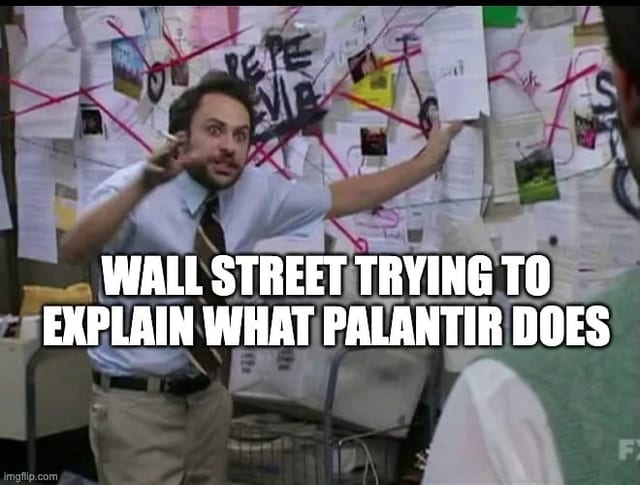
If investors can’t understand something, what hope do us normal people have?
It’s an interesting article, and I can boast that I almost made it till the end (it gets technical).
But after reading it, I still didn’t completely understand what it was that Palantir does. They sound sort of like a software company, but also not a software company. And a services company that’s also not quite a services company.
Surely they can’t be complete shits, existing solely to enable the destruction and displacement of vast swathes of humanity? Can they?
I still don’t know how to pronounce it
My intrigue didn’t dissipate.
I picked up a copy of The Philosopher In The Valley by Michael Steinberger, to learn more about the company and its CEO Alex Karp (sort of the man behind it, but also sort of not the man behind it, because the man behind it is Peter Thiel, sort of… it’s complicated), and about what makes their business operations so impenetrably difficult to explain.
(Let me say that I would absolutely not recommend that book at all; it’s a fawning obsequiosity-fest that doesn’t challenge Karp or anything Palantir does or ever did, and maintains a distanced non-critical view of everything. For a book whose blurb states the company is “at the nexus of the most critical issues of the 21st century,” it doesn’t even allow any arguments against their supreme benevolence to enter the room, let alone get any kind of voice. The book doesn’t so much make me want to give it two thumbs down as it does completely amputate both my thumbs. That kind of thing.)
So let me give you a quick digest on my understanding of how the company came about and what it does.
I have a feeling that if you work in digital analytics, you might not find this quite so outlandishly removed from the work that an analytics consultancy might find themselves doing:
- Shortly after its inception in 1999, PayPal needed a way to prevent fraudulent activities (stolen credit cards, scams, money laundering, etc.), of which there were too many
- Blocking certain users after the fact was whack-a-mole and retrospective, so wasn’t really all that useful
- They looked at their data to find common patterns of behaviour exhibited by users that end up making fraudulent transactions
- They then set up a detection program that would try to find these users before they were able to commit any fraudulent activities
Aside from the chilling parallels to the precrime unit in Minority Report, does this not sound like a version you might reasonably go to a client with and offer as a piece of analysis work?
Swap out “fraudulent activity” with “purchase” and, particularly over a long buying cycle, you might actually have a product you’d sell to a client.
How Palantir got big
Here’s (broadly) what happened next:
- After 9/11, investigations determined that there was likely more than enough information bouncing between US intelligence services to have prevented the attacks; it just wasn’t connected in one place
- PayPal wondered whether the predictive, pre-emptive techniques they’d designed for their own anti-fraud uses could be deployed to anti-terrorism for the US government, and subsequently the rest of the world
- Thus: Palantir
So, yes, this means that the company “at the nexus of the most critical issues of the 21st century” was basically born out of someone wondering whether the intellectual property they’d developed for one purpose could also be used for another purpose.
Just goes to show the raw power of productisation of services, amirite?
So this means that the most impenetrably opaque company of our times does this:
- Ingests data from anywhere
- Makes different types of data talk with each other
- Provides an interface to interrogate that data
- Probably bundles a dashboard or two and calls it a retainer
(OK I made that last one up, but I expect it’s true.)
If you’ve worked with complex organisations (governments yes, but also big retail groups, universities, sprawling media companies) then you will have seen these sorts of problems first-hand.
One database lives over there, the other lives over here. Porting data from one to the other takes several days, which means weekly reporting is outdated by the time it’s delivered. Have you ever heard a client say “perhaps you could spin something up for us in GCP that would speed this up?” Well, that’s exactly what Palantir does, but at a big and beefy scale.
Forward-Deployed Engineers (FDEs)
Palantir is famous for two things.
The first is the military, surveillance, and anti-human ocean-boiling nastiness they are involved in.
The second is having Forward-Deployed Engineers (FDEs), which (as far as I can work out) is essentially a couple of technical people that work in a client’s offices, on their systems, in their teams, and rubbing shoulders with client internal staff.
I can think of no better way to find, understand, and generate solutions to client problems than spending time with them.
This is why agencies place such heavy importance on things like the QBR, or the semi-annual Strategy Day, or taking the CMO out for dinner.
Exposure leads to knowledge, knowledge leads to opportunity, and this in no small way is why companies like Google, Accenture, Databricks and loads more I’ve never heard of are ramping up their FDE-ness, acting as though they’ve been doing it all along and are just calling it trendy now. (Hat tip to Wipro, who have been doing the FDE thing without calling it anything since the dawn of time. No doubt there are others.)
Here’s a snip from The Philosopher In The Valley that made me actually realise how gobsmackingly close the FDE experience is to that of the analytics agency:
Mark Elliot, who led the forward-deployed engineering team, says it was a “discovery phase,” and what he and his colleagues discovered was that, as challenging as the data integration problems were at government agencies, they were even more acute on the commercial side. Palantir had one client, a multinational insurer, whose biggest customer was an international restaurant chain. It was a lucrative relationship, but astonishingly, the insurer had no idea if it was actually profitable. “They had a hundred different databases,” Elliot recalls. “They mapped the customer’s name a hundred different ways. The contracts were in many different languages. Their business was fine, they were getting paid. They just didn’t know if they were making a profit on the relationship. And we were thinking, Man, how can that be?” It was clear to him and others that even major corporations, despite all the data and resources that they had at their disposal, sometimes lacked even the most basic information about their own businesses.
-- Michael Steinberger, The Philosopher In The Valley: Alex Karp, Palantir, and the Rise of the Surveillance State
I mean… how familiar does that sound? A business having loads of data, but being unable to link it all together and as a result, also being unable to answer basic questions about it. Hooray!
It rings in my ears with the sound of a thousand “how did the meeting go” debrief conversations all crying out in unison…
Forward-Deployed Analysts (FDAs, I suppose)
Perhaps this means, then, that assembling bits of your team and embedding them directly in client teams is the way to go?
If you have a talent bench as fraudulent expansive as that of Manchester City, then no worries at all on that front: you have resources to spare!
Send them to client sites! Let them fly and be free! Welcome them back with open arms and share options when they return with the gold!
Real life isn’t like that though, is it.
You don’t have infinite resource, but perhaps there are ways of replicating the benefit without committing to the over-hiring danger?
Some things to think about:
- You’re always going to find (and win) more work proactively, than reactively. If your pipeline activities are mostly waiting for clients to get in touch and give you a mission, then that’s not really a pipeline. Forward-Deployment of some kind will make a difference to your revenue.
- Send one client management person, and one technical person, to spend a day physically in a client’s offices. Have a workshop take up 2 hours in the morning, pay for the client’s lunch, then spend the afternoon physically at desks understanding problems. (Up to you whether you charge for time, or do this pro bono. I’d be inclined to charge for the workshop bit, but not for the afternoon session.)
- Pods of specialists (tech, analysis, other capabilities) assigned to specific clients can help surface client problems that nobody else noticed. Individuals can work across multiple Pods, so there’s no requirement for a super-deep talent bench
- What’s the difference between “a 30-hour monthly retainer” and “a fractional resource embedded one day per week within your team”?? Not much, I would say -- but the concept of a fractional resource implies greater consistency of service, and essentially gives you an FDE/FDA with guaranteed, easy-to-forecast workload
But my technical people can’t sell!
That’s kind of a different problem, and one that I think can be fixed by internal training, in which you reframe what it means to “sell” something.
In Pods, on-site days, and anything else you come up with, try and pair one “strongly technical” person with another “not super strong technically but has a really good commercial understanding of how all this works”, noting that you likely have more of the former person than the latter.
(I can and will write more about this. It’s a problem we have in the industry, probably because of the huge gulp of implementation work we’ve all undertaken in recent years. As a result, I think we have too many Simos and not enough Avinashes.)
So where does that leave us?
I’m not saying go and be Palantir. I’m not saying that your services should be bundled and offered to law enforcement or to ICE.
What I am saying is that the concept of FDEs (or FDAs if you prefer that) could be the difference between modest growth next year, and significant growth next year.
“Faint heart never won fair retainer” is something I am embarrassed to admit having said out loud on more than one occasion, but it’s something I believe. You don’t get great results by waiting for the phone to ring.
FDAs just take this concept, and apply it a little more forcefully.
If you’re doing this already, or if you’re planning on doing it sometime soon, I’d be very interested to hear of how effective you’re finding it.
But hey, enough of my yakkin’. I’ll catch you next time!
Thanks for reading. No AI was used in the creation of the words you just read.
I do this for a living. I work with agencies and consultancies around the world, providing the support I wish I’d had throughout my journey of starting, scaling, and selling an agency.
If you think you could benefit from what I know how to do, I welcome conversation: drop me a line at [email protected].
On this site, you’ll also find information about the Analytics Consultants Circle, a free monthly peer-group call that I moderate, where solo and small-team consultants share battle stories from the field, and we talk about the challenges you face when you grow and scale a business.
The last movie I watched: The Double Life Of Veronique (1991). Racy.
The Business of Analytics lands fortnightly. If this one was useful, the next one probably will be too.
Subscribe ↗